
The Eno River was named after a Native American tribe known as the Haynoke, Oenoke, or Enoe Indians. The Eno River Association (ERA), Eno River State Park, and West Point on the Eno are located on the traditional and ancestral homelands of the Eno, Shakori, Sissipahaw, Occaneechi, and other Siouan-speaking peoples, as well as their descendants, the Occaneechi Band of the Saponi Nation.
Introduction
Following the creation of the ERA—and its early successes protecting the Eno from major threats in the late 1960s and early 1970s—the work to safeguard the river continued to grow in both scale and ambition. A pivotal shift came with the movement to establish a state park along the Eno. Through years of advocacy, including hikes, history walks, and public education efforts, support steadily built for a protected park.
In 1970, an Eno River feasibility study was approved. This study identified six potential sites for what would become Eno River State Park: Giles Ford to Cates Ford; the Big Bend; Guess Mill to West Point Mill at Roxboro Road; Roxboro Road to Oxford Highway; Willie Duke’s Bluffs; and 300 acres extending to Red Mountain. The dedication of the ERA, alongside community advocates and partner organizations, laid the groundwork for a protected landscape that continues to benefit the region today.
Eno River State Park
In May 1972, the ERA partnered with The Nature Conservancy to advance the vision of a state park along the Eno. Holger and Margaret Nygard presented the proposal to the State Parks Committee, and the North Carolina Board of Conservation and Development approved and endorsed both the concept and the acquisition of land.
The original plan envisioned a 20-mile stretch of protected river corridor, connecting to the Neuse reservoir and forming a greenbelt crescent within a rapidly developing region.
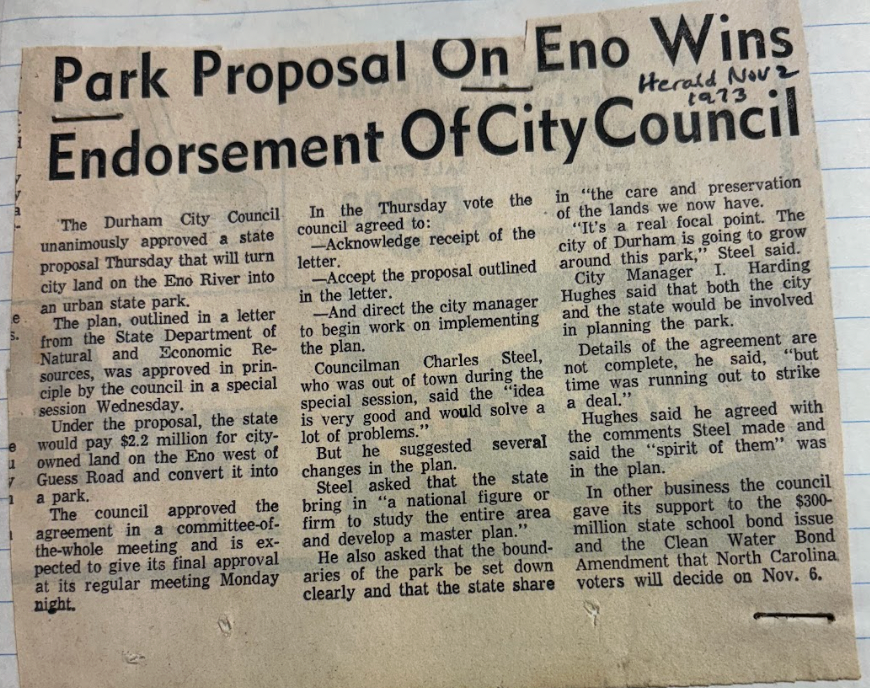
In 1973, the park’s first 90 acres were acquired through a generous donation from Dr. and Mrs. Frederick Bernheim. That same year, a special Eno River project group was formed as a branch of The Nature Conservancy. Working in collaboration with the ERA and the North Carolina Division of State Parks, the group helped acquire 328 acres for the park, including 300 acres previously purchased by The Nature Conservancy in 1971.
Support for the park continued to grow, with backing from the Orange County Commissioners, the North Carolina Conservation Council, the North Carolina Wildlife Federation, and other organizations.
On June 15, 1973, following a cooperative effort between the City of Durham, Orange County, the State of North Carolina, The Nature Conservancy, and the ERA, Governor James Holshouser formally welcomed Eno River State Park into the North Carolina State Parks system.
By 1974, the first park ranger had been assigned. Among the early rangers was Jan Truitt, the first woman hired as a ranger in the North Carolina State Parks system. Reflecting on her experience, she shared, “I was just amazed at how beautiful everything was… there were so many special things about this river that ran through a fairly developed region. It was so impressive to me to see what was there and what people went through to protect it. Those of us at the park were glad to be a part of all of that. We worked with some amazing people.”
Not all efforts aligned with conservation goals. In 1975, a group of farmers formed the Eno River Group, advocating for the land to remain privately owned as farms and woodlands. However, these efforts did not come to fruition, as the ERA and its partners successfully conserved the land for the state park and other protected areas.
That same year, the first 1,000 acres of the park were formally opened to the public. In 1976, a master plan was developed, which included the recommendation for a footbridge across the river.
Margaret Nygard captured the spirit of the movement in the January 1982 publication of the Wildlife in North Carolina magazine, “You walk along the river there and you know you’ve got to stand up for it, you’ve got to preserve it. It’s too good to lose.”
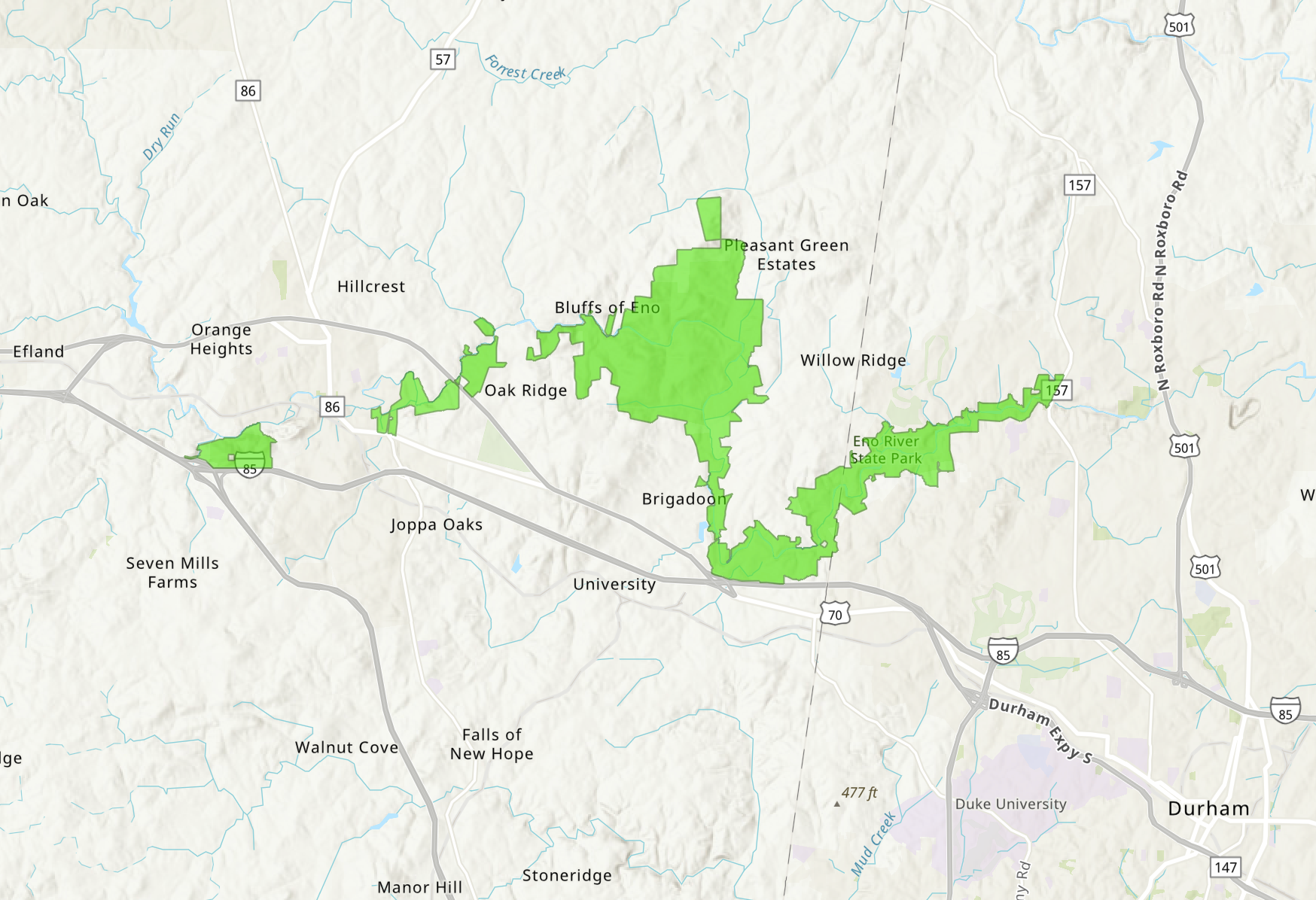
Through sustained advocacy and collaboration, a 20-mile park along the Eno River was established—creating a vital green buffer against urban sprawl. Today, Eno River State Park protects more than 4,500 acres.
West Point on the Eno
Another critical effort to protect the Eno River focused on what is now West Point on the Eno.
In the late 1960s, the City of Durham sought to create a city park along the river, including access from Roxboro Road and preservation of the historic McCown-Mangum estate and West Point Mill. Around the same time, in 1968, Ervin Industries (Ervin) purchased approximately 700 acres of land along both sides of Roxboro Road, with plans to develop a shopping center on the east side and office towers and condominiums on the west.
As development plans progressed, the ERA worked to build public support for protecting West Point. Margaret Nygard organized hikes and educational programs to raise awareness of the site’s cultural and environmental significance. During this period, the estate and mill fell into disrepair, and surrounding land was cleared.
Before demolition of the estate house could occur, the ERA successfully advocated for an Environmental Impact Statement. This effort ultimately led Ervin to sell the land—including the house and mill—for the creation of a city park, while proceeding with commercial development on the opposite side of Roxboro Road.
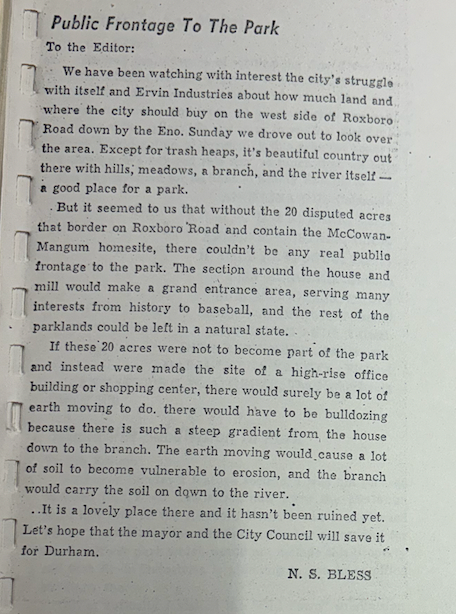
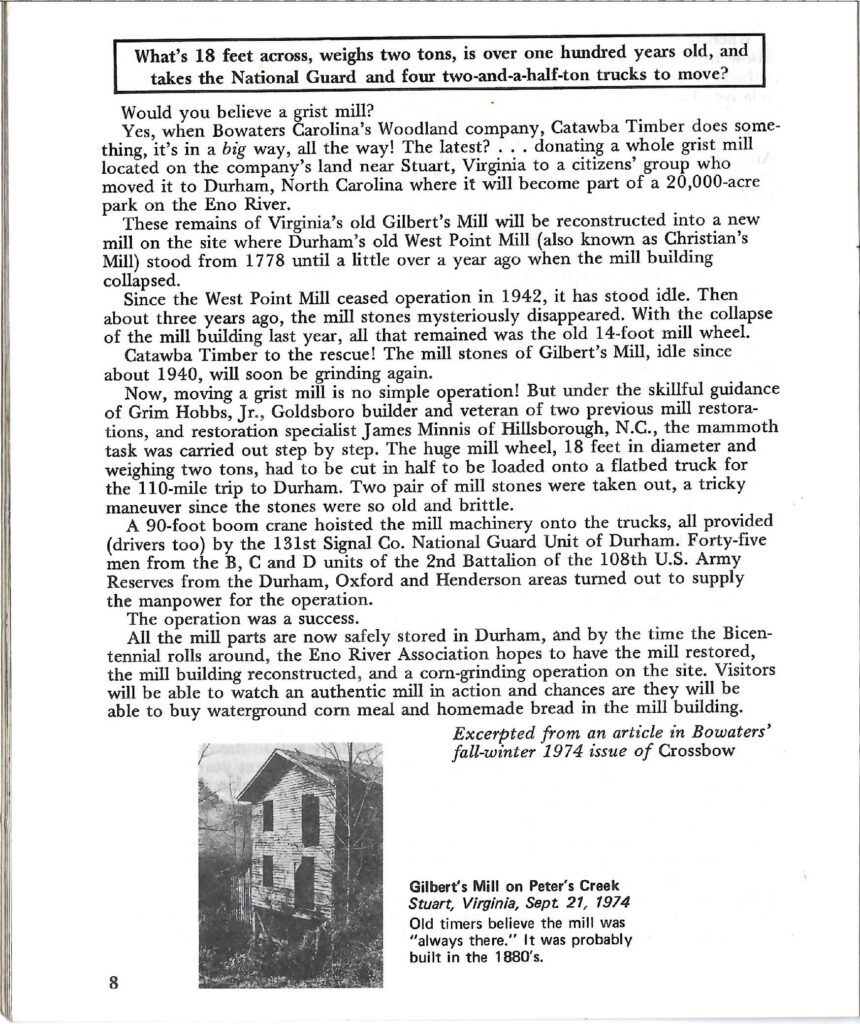
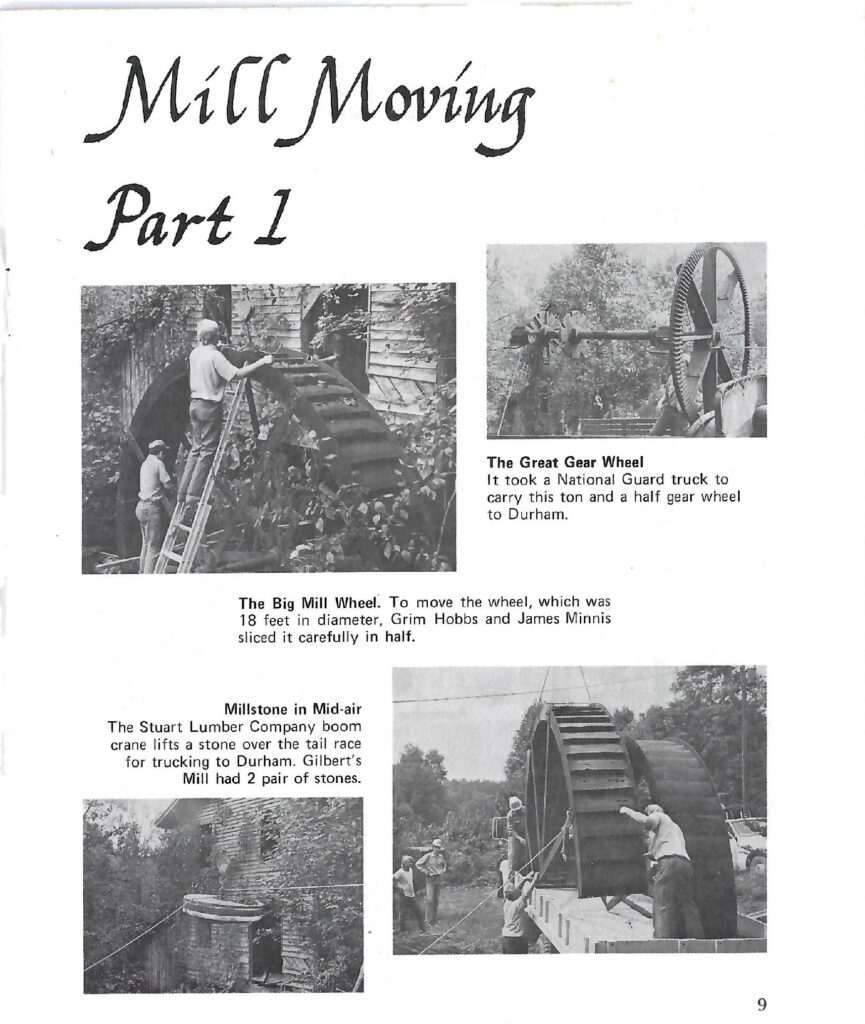
In 1973, as plans for the park and restoration were underway, the mill collapsed. Using historic photographs and salvaged materials, the mill was reconstructed—incorporating parts transported from Gilbert’s Mill in Stuart, Virginia. The 18-foot, two-ton mill wheel had to be cut in half for the 110-mile journey to Durham. This reconstruction was guided by Grim Hobbs Jr. and restoration specialist James Minnis.
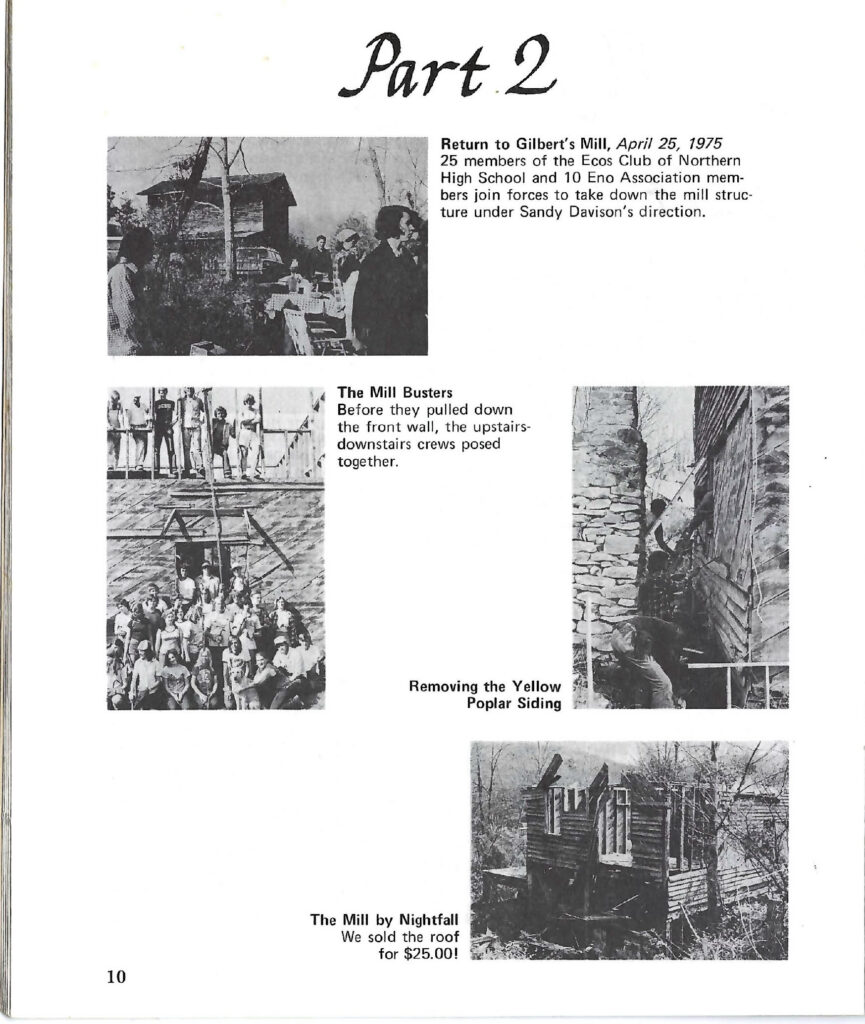
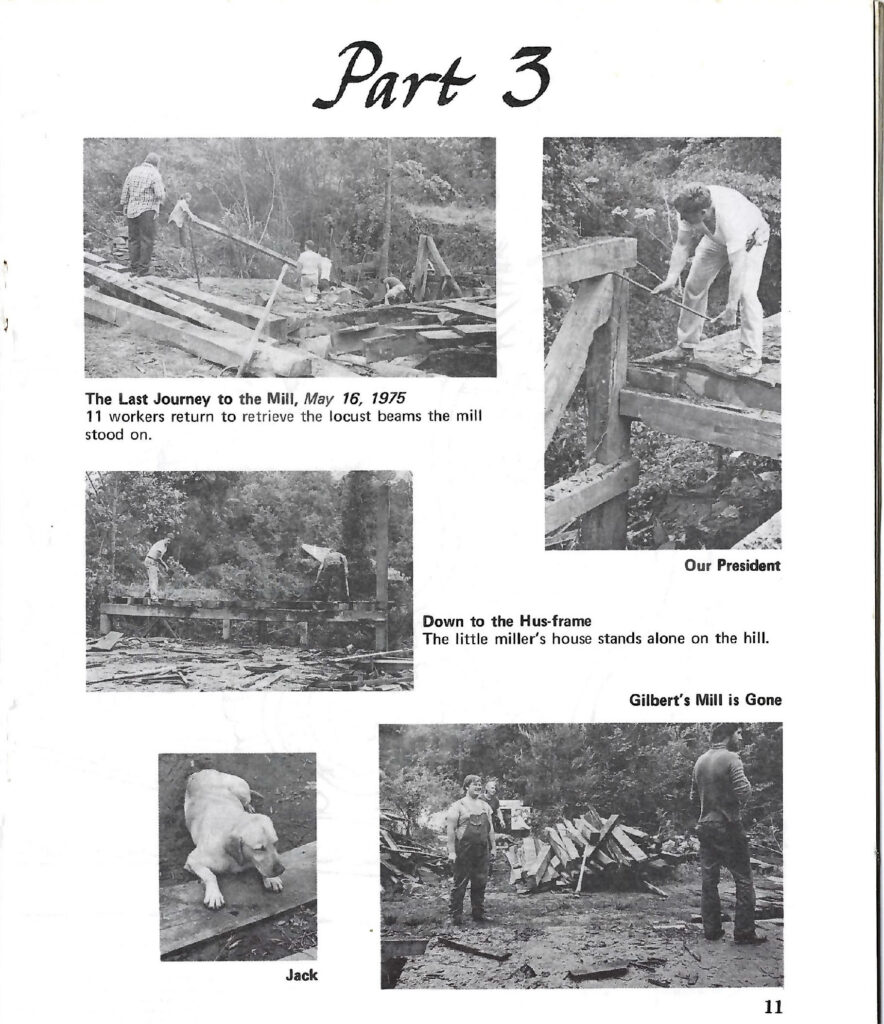
At the same time, the McCown-Mangum house was restored and converted into a museum. A master plan for the park was developed in 1974, and in 1975, the Durham City Council established the Friends of West Point organization to support the park’s development and preservation.
West Point on the Eno was dedicated in July 1976. By 1978, the reconstructed mill was once again capable of grinding corn and wheat using water power. Originally in continuous operation from 1778 to 1942, the mill’s restoration—supported in part by the ERA—marked a significant milestone in preserving the site’s history. Margaret Nygard, who chaired the mill committee in 1978–79, helped raise funds by selling milled corn.
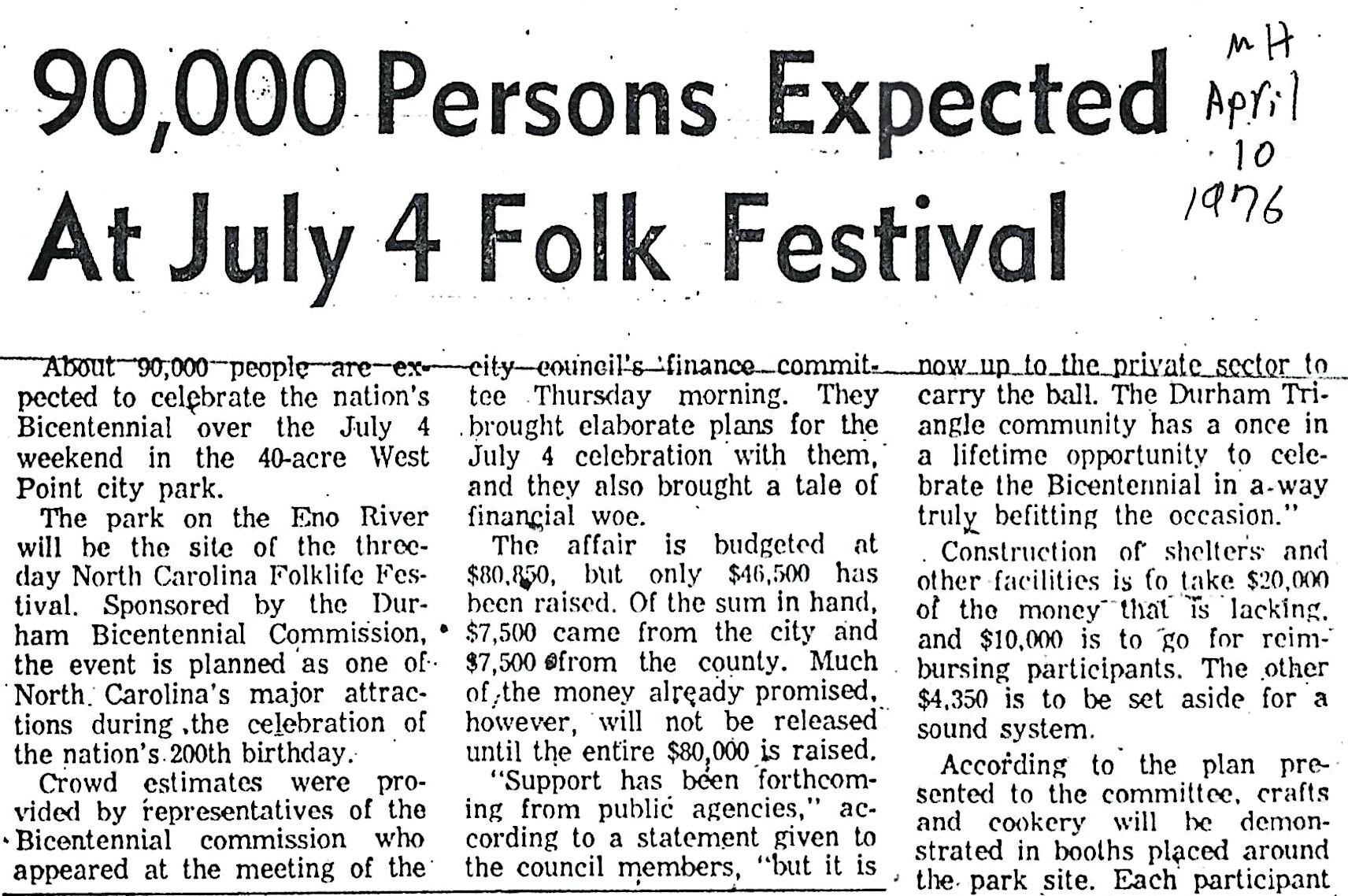
West Point quickly became a vibrant community gathering place. In July 1976, it hosted the North Carolina Bicentennial Folklife Festival—the largest bicentennial event in the state—bringing together craftspeople, musicians, and artists to celebrate North Carolina’s cultural heritage. Approximately 90,000 people were expected to attend the 3-day event.
The success of the Folklife Festival led to additional festivals in the following years, including a 1978 festival produced under the direction of the state’s newly established Office of Folklife Programs. This growing momentum helped establish West Point as a hub for cultural events and ultimately inspired the first Festival for the Eno, held there on July 4, 1980—beginning a tradition that has continued for decades.
The Eno River State Park Today
Since its founding, Eno River State Park has grown to more than 4,500 acres of protected land, with much of this expansion driven by the ERA’s land protection efforts. Today, it is one of the most visited parks in the North Carolina State Parks system, welcoming over one million visitors each year.
The park offers more than 36 miles of trails, along with historic sites, campsites, picnic areas, and diverse opportunities for recreation and reflection. As park ranger Zac Cowan described, “The community of visitors around us flows through the park much like the river, and it’s not often I go a day at work without seeing someone new enjoying themselves here.”
Maintained by park staff, ERA volunteers, and partners such as the Friends of the Mountains-to-Sea Trail, the park remains a vital green space within an increasingly urbanized region.
Erik Nygard, a longtime employee and advocate for North Carolina’s state parks, reflected on the ongoing nature of this work, saying, “The number one thing I’ve learned through my work in State Parks is that we should never consider that our work or a park is complete.”