In its early years, the Eno River Association (ERA) faced major challenges in protecting the river’s natural resources and the benefits it provided to surrounding communities. The dedication of the earliest supporters of the preservation of the Eno River Valley laid the foundation for the river-centered land conservation, community events, and vibrant community that ERA continues to nurture today.
The Threat of the Dam
For many years, the Eno River remained a largely undisturbed, biodiverse space primarily known by locals, hikers, and fishermen who appreciated it for its beauty. However, as Durham grew, new businesses and developers viewed the river as an untapped supply of wealth and resources.
One large industry proposed damming the Eno to build a reservoir as a solution for water shortages. But when word spread to local landholders, a movement to protect the river began.
Margaret and Holger Nygard, who had recently moved onto land adjoining the river, had quickly grown to appreciate its pristine serenity. They also recognized how protecting the Eno could benefit the wider community. Holger, then a professor at Duke, recalled: “There was talk about putting a dam on the Eno. We were living here at the time. I immediately went down to City Hall on Monday night and protested vigorously. People listened.” Many other landholders and Duke connections helped to spark early protests against the reservoir.
Jean Anderson, another key advocate, added: “Margaret and those we knew with property on the river began to explore ways to combat the city’s plans to dam the river. We recruited sympathizers, and other landholders along the river, and made futile appeals to the planners and city council.”
Founding ERA
As landholders, professors, and early supporters took action, the idea of forming an organization to protect the Eno first emerged in 1965. By 1966, these efforts became reality with the founding of the Association for Preservation of the Eno River Valley, Inc.—informally known as ERA. The organization was born from a collective, grassroots effort that turned early advocacy into a lasting institution dedicated to protecting the river.
ERA worked to foster public appreciation of the Eno through wildflower hikes, history talks about sites like the old mill, and inventories of local flora. Margaret Nygard reflected: “There were two things we had to do to gain widespread public acceptance… one was to come up with a positive plan for the Eno. The other was to get people out on the river so they could see what they were fighting for.”

Margaret shared that the first hike attracted 200 participants, while the second drew over 450, demonstrating how quickly community support was growing. The fight to stop the reservoir lasted eight years, fueled by countless hours of advocacy from landholders, community members, and others dedicated to protecting the river.
Advocacy like this has always been—and continues to be—foundational to ERA. Without the leadership of Margaret Nygard and the earliest supporters of the Eno River, ERA—and today’s access to natural spaces, educational programs, and stewardship events—might not exist.
Persistent Threats
Even as the community grew, new threats to the Eno emerged as growing industries persisted. In 1966, a developer proposed a large apartment complex on the river. In 1968, plans for a beltline threatened to bulldoze two miles of river while failing to preserve greenbelts, putting water quality and biodiversity at risk. After a drought that same year, the dam and reservoir idea resurfaced to restore water supply.

In 1970, a shopping center wanted riverfront land. In 1971, a proposed sewer line would cross the river at least 24 times over eight miles, turning each tributary into a sewage feeder line. In 1973, a proposed landfill threatened nearly 160 acres along the river. Through tireless advocacy—in the form of educational outreach, fundraising, and community events—ERA successfully opposed or modified each of these projects, safeguarding the Eno River for future generations.
Growing Public Support
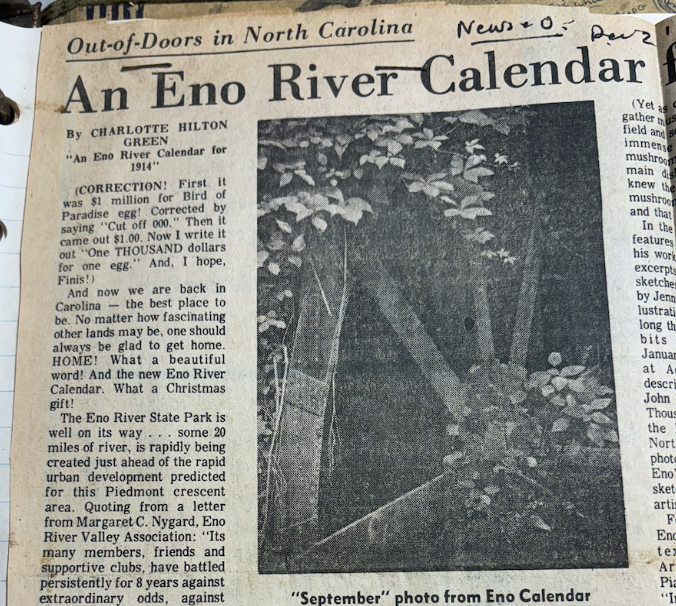
One advocacy initiative was the Eno River Calendar, first published in 1972 as part of ERA’s early fundraising efforts. The original calendar featured hand-drawn illustrations of local species, historical facts, and environmental education pieces to foster ongoing support for river conservation. Today, the calendar remains a cherished tradition, designed each year by a dedicated committee with contributions from local photographers.
Partnership with the Nature Conservancy
ERA’s early work to protect the Eno River included a critical partnership with the Nature Conservancy, which began during the fight against the proposed dam. Early efforts focused on protecting private lands from being overtaken, but guidance from a Conservancy representative helped shift the strategy. Holger recalled: “[The representative] told us to stop pleading our own personal causes about losing our land to the dam and instead focus on a larger, public purpose. It was then Margaret began her drive for a state park.”

With this new vision, ERA worked with the Nature Conservancy to protect the river through the creation of a state park. By 1972, the Conservancy’s Board and State Parks Committee agreed that property could be acquired for this purpose. After Dr. and Mrs. Frederick Bernheim donated the first 90 acres, Governor Holshouser accepted four tracts of land in June 1973. With that, a 20-mile-long park along the Eno River was established, providing a green buffer against urban sprawl and marking the beginning of the state park that continues to preserve the river today.
The Legacy of Early Advocacy
The early years of ERA demonstrate the transformative power of community advocacy. The dedication of Margaret and Holger Nygard, Jean and Carl Anderson, the Bernheims, and countless others preserved the river’s biodiversity, protected water quality, and expanded public access for generations to come.
Jean Anderson reflected on those early days: “It’s remarkable to me how [ERA] has flourished… Did someone tell me that there were 14 people? My goodness, when I think of Margaret with a sheet of paper, you know. That was the extent of our office.” From such humble beginnings, the vision and determination of these individuals turned the fight of a few landholders into a thriving organization.
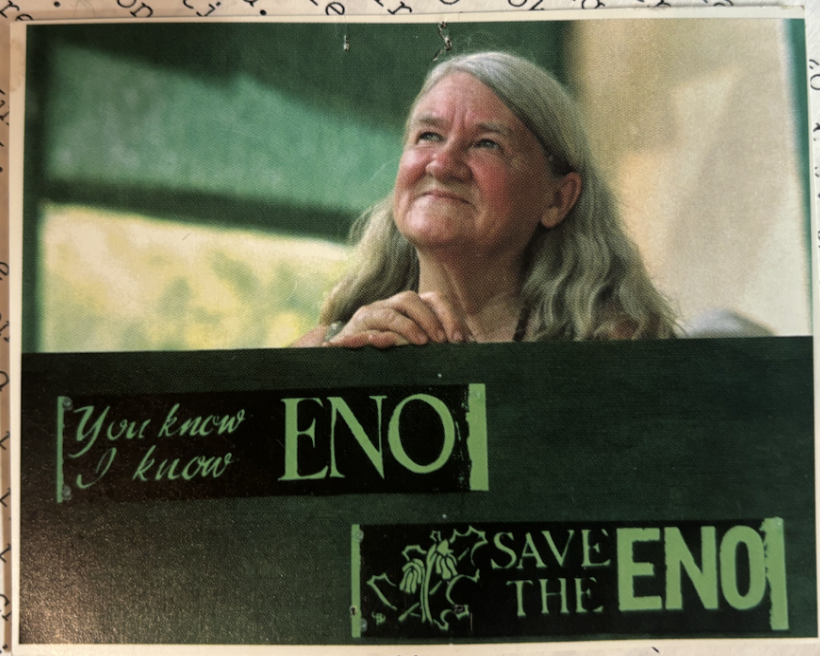
Today, as ERA celebrates its 60th anniversary, the Association continues the fight to conserve and protect the Eno River through education, stewardship, and conservation, ensuring its natural and cultural legacy lives on.