
The Eno River was named after an Indigenous tribe known as the Haynoke, Oenoke, or Enoe Indians. The Eno River Association, Eno River State Park, and West Point on the Eno are located on the traditional and ancestral homelands of the Eno, Shakori, Sissipahaw, Occaneechi, and other people of Siouan descent, as well as their descendants, the Occaneechi Band of the Saponi Nation.
As the Eno River Association (ERA) entered the 2000s, the organization reached an important milestone in its evolution. For much of its history, ERA had worked alongside partners to advocate for and secure the protection of the Eno River’s most treasured landscapes. As the organization grew from an all-volunteer effort into one supported by professional staff, it gained the capacity to acquire, steward, and manage protected lands of its own.
No project better represents this transition than the Confluence Natural Area.
While ERA continues to work closely with local governments, conservation organizations, and landowners to protect important places throughout the watershed, the acquisition of the Confluence marked one of the first times the organization led the effort to purchase and permanently steward a large conservation property.
As ERA Land Stewardship Manager Indigo Roper-Edwards explains,
“We had one or two [properties] prior to that, but the Confluence was one of the first large parcels that was a priority of ours for land protection, but was not for our standard partners.”
Protecting the Confluence
When the opportunity arose to protect the Confluence, neither Orange County nor Eno River State Park was in a position to acquire the property. Recognizing its exceptional ecological importance, ERA stepped forward to lead the effort.
The preserve protects the place where the East and West Forks merge to form the Eno River itself—its very beginning. From this confluence, the river flows nearly 40 miles through Orange and Durham counties before eventually reaching Falls Lake.
The Confluence Natural Area encompasses two North Carolina Natural Heritage Areas: the Confluence Natural Area and the Eno River Aquatic Habitat. These protected habitats support an extraordinary diversity of wildlife and native plants, including indigo buntings, big brown bats, eastern red bats, Cope’s gray treefrogs, yellow giant hyssop, and the rare purple fringeless orchid. In 2022, campers participating in Eno River Field Station helped document the first recorded eastern spadefoot toad in Orange County in decades—a reminder that the preserve continues to reveal new ecological discoveries.
Today, visitors can experience the landscape through four public trails: Two Forks Trail (1.9 miles), Rocky Water Path Trail (0.5 miles), Big Meadow Loop (1.3 miles), and Poplar Bend Loop (2 miles).
Building the Preserve
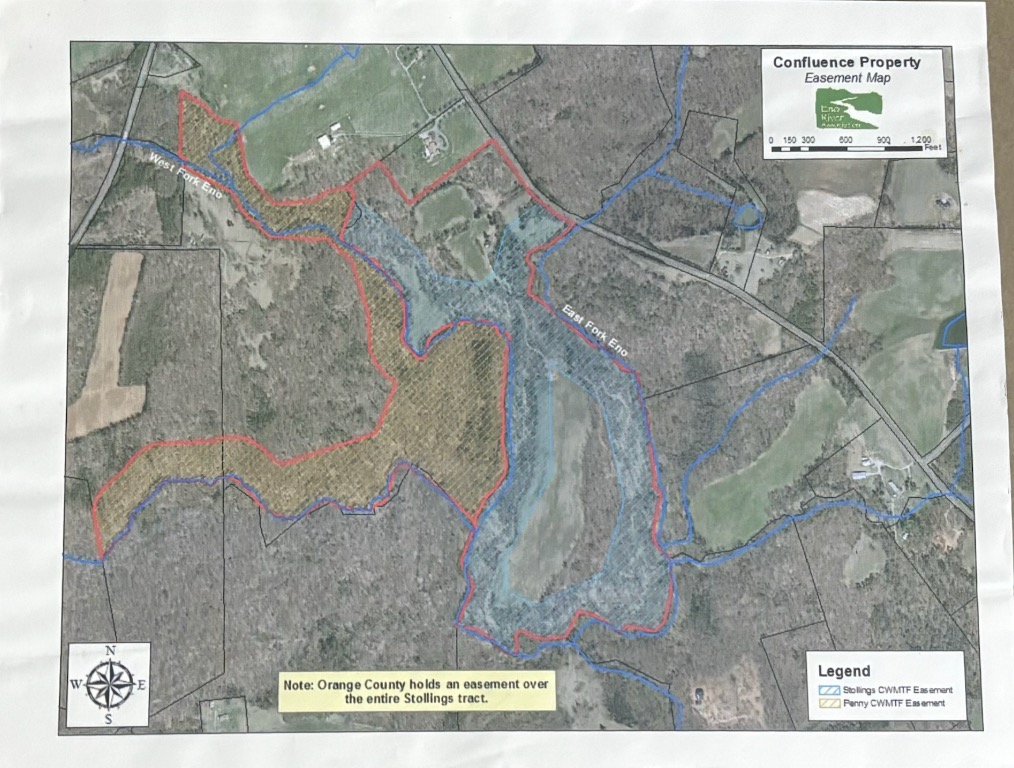
The Confluence Natural Area was not acquired all at once. Instead, it was assembled over fifteen years through four separate land acquisitions, gradually creating the 270-acre preserve that visitors enjoy today.
Long before it became a nature preserve, the property was home to farms dating back to the 1700s. Evidence of that history remains, including the site of an old water mill located along Rocky Water Path Trail.
The first acquisition came in 2007, when ERA purchased the 110-acre Stollings property with support from Orange County, the City of Raleigh, and the North Carolina Land and Water Fund (NCLWF). This parcel now serves as the main public entrance to the preserve.
A year later, the 69.9-acre Penny Lot expanded protection west of the West Fork with funding from the City of Raleigh and the NCLWF. In 2017, another 22.66 acres along the East Fork were added with support from the NCLWF and Orange County. Finally, in 2022, the acquisition of the 69.2-acre Penny Lot 2 completed the preserve’s current footprint through funding from the Brown family.
Each acquisition strengthened protection of the Eno River’s headwaters while creating a larger, more connected landscape for wildlife and future generations.
The Confluence Today
The Confluence officially opened to the public as a nature preserve in 2018. Initially open only on weekends, visitation increased dramatically during the COVID-19 pandemic as more people sought outdoor spaces to explore and reconnect with nature. In response, ERA expanded access, and the preserve has remained open seven days a week ever since.
Today, the Confluence is ERA’s largest and most accessible nature preserve. Its trails, pavilion, forests, streams, and open fields provide space for recreation, education, volunteer stewardship, and community gatherings. Dedicated volunteers have played a vital role in maintaining trails, restoring habitats, and caring for the preserve since its opening.
Beyond its recreational value, the Confluence remains one of the region’s most important conservation landscapes. Extensive forests and protected stream corridors safeguard the headwaters of the Eno River while providing habitat for countless native species. Restoration efforts are currently transforming former agricultural fields into native Piedmont prairie and forest, creating an even richer mosaic of habitats that will benefit pollinators, birds, and other wildlife.
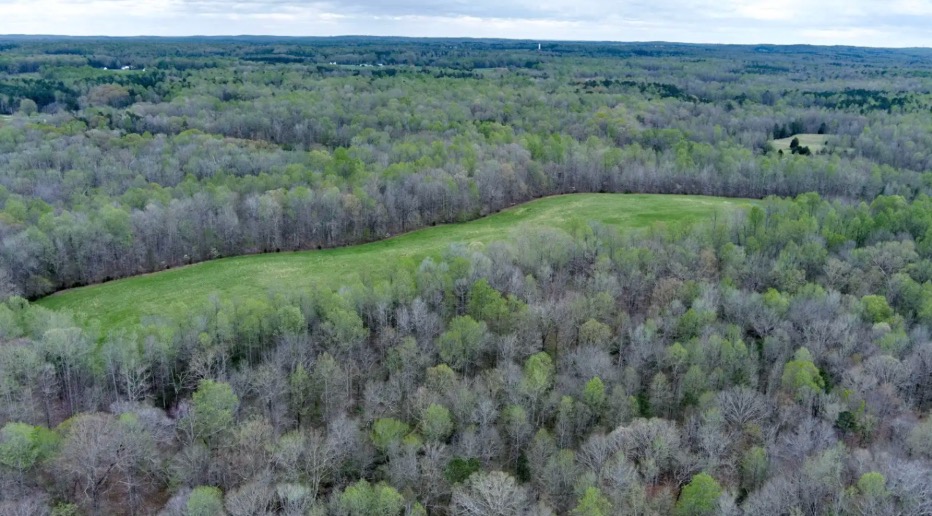
Protecting the Confluence also protects clean water. The preserve helps safeguard the East and West Forks of the Eno River, supporting water quality for Hillsborough and contributing to Falls Lake, an important drinking water source for the Triangle.
The Confluence has become a hub for connecting people with nature. Volunteer stewardship workdays, forest therapy hikes, walking stick whittling workshops, Eno River Field Station summer camps, and the Eno River Association’s Annual Meeting all take place here throughout the year. For many nearby residents, the preserve has become a favorite place to hike, volunteer, learn, and experience the river firsthand.
The Confluence Natural Area stands as more than just one of ERA’s preserves. It represents a defining chapter in the Association’s history—a place where decades of advocacy evolved into lasting stewardship, ensuring that the place where the Eno River begins will remain protected for generations to come.