
The People Behind the Name
The Eno River takes its name from the Eno (also recorded as Haynoke, Oenoke, or Enoe) people. Today, the Eno River Association and Occoneechee Mountain State Natural Area are located on the traditional and ancestral homelands of the Eno, Shakori, Sissipahaw, Occaneechi, and other Siouan-speaking peoples, whose descendants include the Occaneechi Band of the Saponi Nation.
Near Occoneechee Mountain is the Occaneechi Village Replica Site, home to a reconstructed 17th-century Occaneechi village on the banks of the Eno River. The site helps preserve and share the history, culture, heritage, and enduring presence of the Occaneechi Band of the Saponi Nation in the Eno River valley.
Protecting a Unique Landscape
Occoneechee Mountain contains a unique collection of habitats unlike those found in much of the surrounding Piedmont. Its steep slopes, rocky soils, and varied elevations support several distinct plant communities, including dry chestnut oak forests along the ridges and cooler, more moisture-rich habitats in lower areas such as Panther’s Den.
The mountain is also home to a variety of rare and notable species, including the Brown Elfin butterfly, silvery checkerspot, Catawba rhododendron, galax, and sleepy duskywing. Acorns and berries produced by chestnut oaks and heath communities provide an important food source for upland wildlife. Rising approximately 700 to 800 feet above sea level, the mountain’s northern face overlooks the Eno River and offers sweeping views of the surrounding landscape.
When Cone Mills, a textile manufacturing facility that had operated near Occoneechee Mountain for decades, closed in the mid-1980s, the Eno River Association (ERA) recognized a rare opportunity for conservation.
![An article depicting a visitor to Occoneechee Mountain holding out his hand overlooking the land, expressing that "Regardless of its height, Cates [is] proud of his mountain" suspending comparisons to larger mountains for the sake of appreciating the Occoneechee mountain for the local community of Hillsborough.](https://www.enoriver.org/wp-content/uploads/2026/06/Felt-it-on-the-Mountain.png)
Building Support for Protection
Efforts to protect the mountain began in the 1960s with the fortuitous decision of the Lloyd family to purchase 66 acres of property along Occoneechee Mountain for protection. Long before it was officially protected, Occoneechee Mountain was a beloved community destination where local residents gathered to hike and enjoy the outdoors.
In 1983, Cone Mills announced the closing of their Hillsborough branch mill, and in 1987, the company donated 29 acres to the Town of Hillsborough, creating the foundation for what would become the preserve.
The ERA organized unofficial public hikes along the mountain beginning in 1989. The first hike attracted more than 60 participants, ranging in age from 2 to 88 years old.
As Margaret Nygard explained while advocating for the mountain’s protection:
“It’s going to take a tremendous amount of coming together and support… right now there’s a lot of wishful thinking and talking going on, but we’re very concerned it will be timbered and then the houses will march right in.”
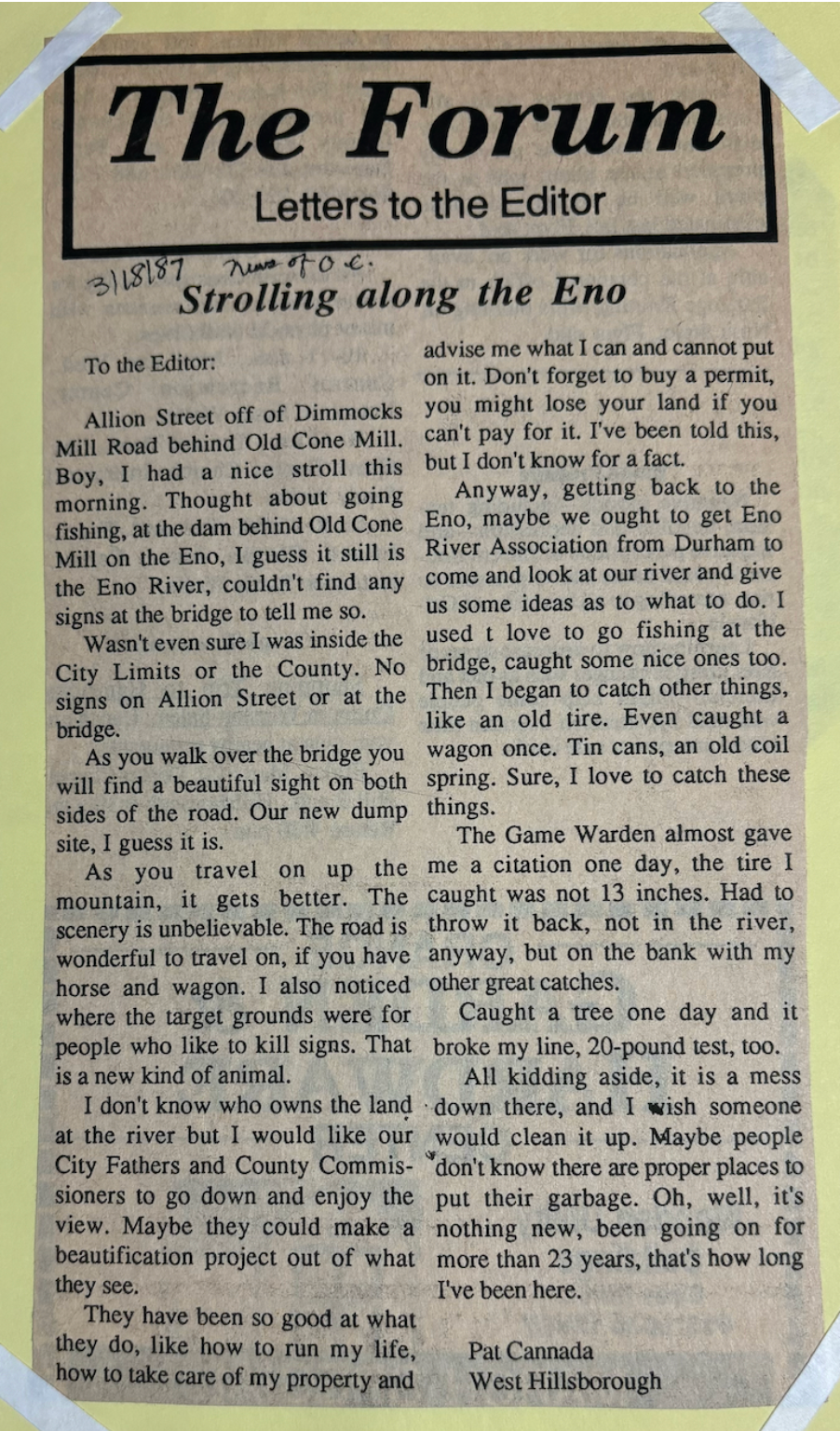
Protecting the property also addressed a growing community concern. The mountain road had become a dumping site for household waste, generating numerous complaints from residents. What had become an eyesore was transformed through community support and investment. As the area was improved, a new bridge was constructed and the road was repaved to provide safer access to the future park.
Expanding the Vision
As the initial acreage was protected, community members and numerous organizations worked together to envision how visitors would experience the mountain’s natural and cultural resources, aiming to highlight the site’s ecological and historical features.
They developed a 1.5-mile loop trail that connected visitors to the ponds, the Eno River, and a historic rock quarry that predates the Civil War. The site was intended to support hiking, fishing, and educational programming. Trail construction and restoration relied heavily on volunteers. Dozens of community members helped clean the property and build trails. Among them was Eagle Scout Josh Drowns, who took on trail construction and maintenance as his Eagle Scout project. He also served as the only youth member on the planning board for the Occoneechee project.
As visitation increased, Piedmont Mineral Company contributed land and access for a 12-car parking area. The addition improved access to the mountain while reducing parking impacts in neighboring residential areas.
In 1993, with Margaret Nygard and George Pyne at the helm, the Eno River Association raised $17,000 to purchase a timber contract on private mountain land. Simultaneously, the NC Division of Parks and Recreation was lobbied to take on Occoneechee as a satellite to Eno River State Park. Funds were soon appropriated from the Natural Heritage Trust Fund to purchase land, and The Nature Conservancy purchased 96 acres for the State.

In December of 1997, Occoneechee Mountain State Natural Area was welcomed into the NC State Parks system. Less than two years later, in the late summer of 1999, the dedication was blessed by John “Blackfeather” Jeffries of the Occaneechi Band of the Saponi Nation, who are the original stewards of the land along the Eno River.
Today, Occoneechee Mountain State Natural Area remains one of the region’s most cherished natural spaces. The property protects ecosystems rarely found elsewhere in the Triangle and serves as an important link in the Mountains-to-Sea Trail corridor.
Margaret Nygard’s Legacy
While the effort to protect Occoneechee Mountain continued to gain momentum, the Eno River Association faced an unexpected and devastating loss.
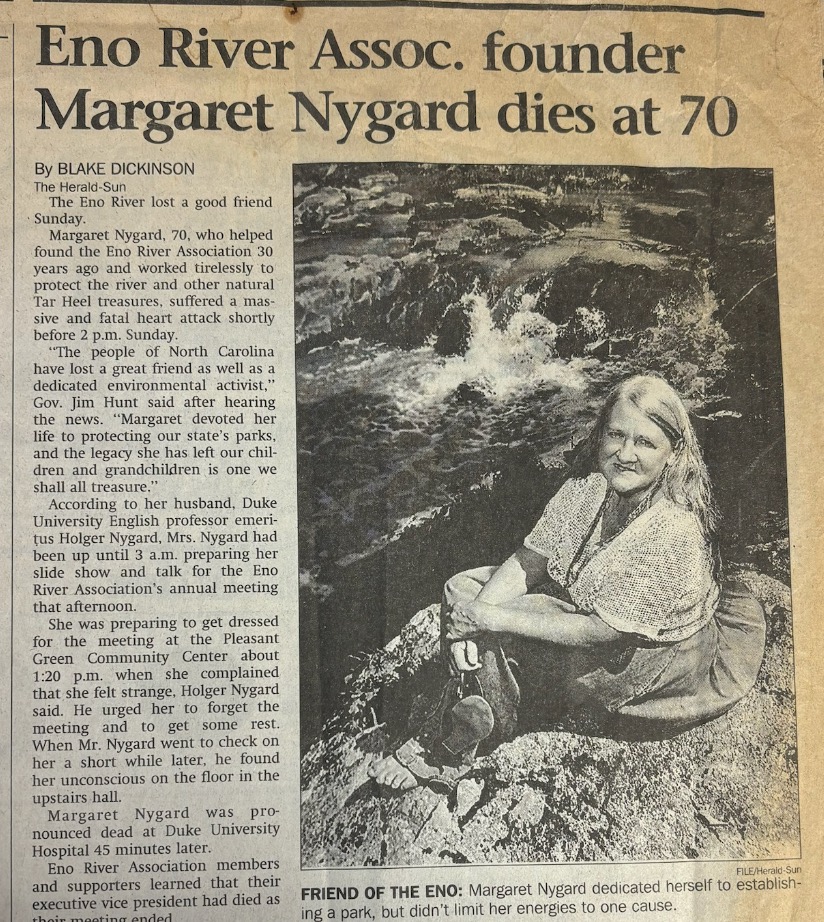
In 1995, ERA founder Margaret Nygard died suddenly of a heart attack at the age of 70. Her passing came as a shock to the many volunteers, supporters, and community members who had worked alongside her for more than two decades. By that time, Margaret’s leadership had become inseparable from the organization’s identity. Through her vision and persistence, she had helped transform a grassroots effort to save the Eno River into one of North Carolina’s most influential conservation organizations.
Reflecting on her impact, ERA President Duncan Heron later said:
“Margaret Nygard was the sage of the Eno. Her tireless efforts and inspiring leadership led to the realization of her vision for preserving the river and the lands adjoining it as the Eno River State Park. She was also active in other conservation efforts throughout North Carolina and was widely recognized for her dedication to environmental causes.”
Margaret’s death marked the end of an era for the Association. In the years that followed, ERA leaders and volunteers faced the challenge of carrying forward the work she had championed. The organization adapted by expanding its staff, creating new leadership positions, and building the capacity needed to continue protecting land, educating the public, and advocating for the river. What had begun as a largely volunteer-driven movement gradually developed into a more structured conservation organization, ensuring that the work would continue for generations to come.
Margaret’s conservation efforts extended far beyond the Eno River. In addition to helping secure land for Eno River State Park, she played a role in protecting William B. Umstead State Park near Raleigh and supported efforts to preserve Jockey’s Ridge on the Outer Banks from encroaching development.
Her contributions earned widespread recognition. She became the first recipient of the Historic Preservation Society of Durham’s Bartlett L. Durham Award. In 1996, she was inducted into the North Carolina Wildlife Federation Conservation Hall of Fame, becoming the eighteenth inductee and the first woman to receive the honor. In 1998, she was posthumously awarded the inaugural Alexander Calder Conservation Award.
Margaret worked alongside countless volunteers, staff members, community advocates, and conservation partners who shared her commitment to protecting North Carolina’s natural spaces. As her friend Ronald Hall reflected:
“Margaret became for us… a model of commitment, of perception, of dedication, of perseverance, of vision, of compassion, of gentleness and toughness.”

Today, Margaret’s legacy can be seen not only in the parks, trails, and protected lands she helped save, but also in the enduring strength of the organization she inspired. The continued protection of places like Occoneechee Mountain stands as a testament to her belief that dedicated individuals working together can preserve the landscapes they love.